






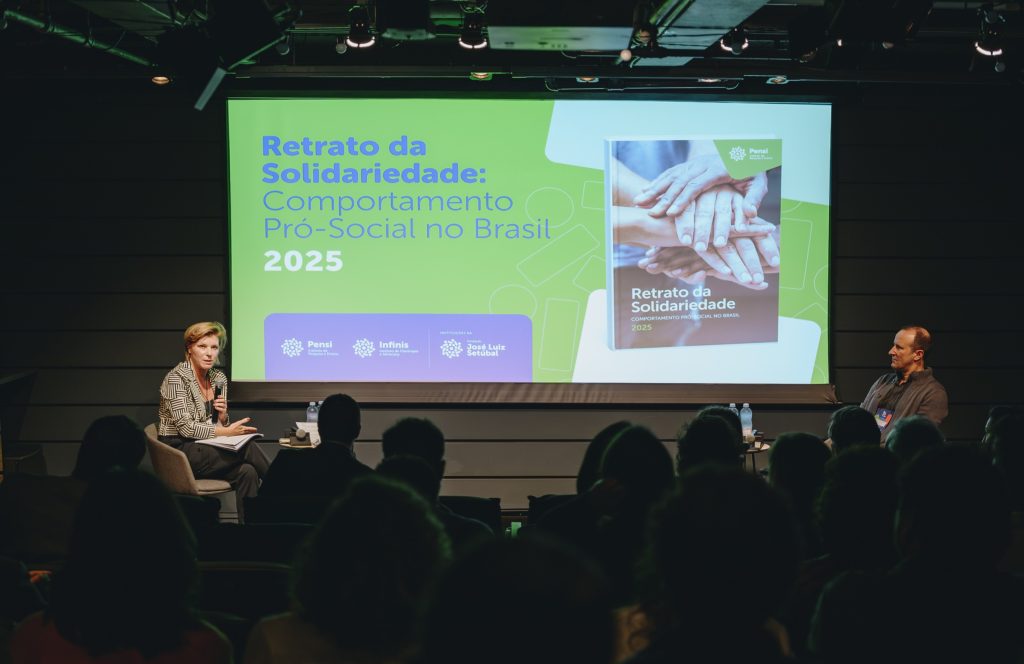
Solidarity is part of Brazilian reality, but still occurs primarily when there is an emergency capable of mobilizing the country. This is one of the main conclusions of the third edition of the national survey ‘Portrait of Solidarity: Pro-social Behavior in Brazil’, launched on July 7 at Itaú Cultural in São Paulo.
Coordinated by the Laboratory of Pro-social Behavior and Public Policy at Instituto Pensi and with support from Infinis, the study annually tracks how the Brazilian population practices different forms of solidarity behavior, such as financial donations, donation of goods, volunteering, and other initiatives supporting Civil Society Organizations (CSOs). Since the first edition, more than 7,500 Brazilians have participated in the research, which uses in-person household interviews across all regions of the country.
During the launch event, Infinis director Márcia Kalvon participated in a panel alongside the research coordinator Flávio Pinheiro and researchers from the Laboratory of Pro-social Behavior and Public Policy Gustavo Araújo, associate researcher, and Ivan Fernandes, affiliated researcher. The discussion addressed the challenges of expanding donation culture and strengthening Brazilian civil society.
Among the main findings of this edition, a concept presented by the researchers stands out: reactive generosity. The data show that solidarity tends to increase in the face of tragedies, campaigns, and calls for help, but loses strength when these situations no longer occupy the center of public debate. In other words, there is willingness to help, but it still depends on constant stimuli. The research indicates that seven out of ten Brazilians say they never talk about donations, while 67% say they do not receive requests for contributions from social organizations.
This dynamic also appears in the general indicators. In 2025, 55.5% of Brazilians provided some type of support to civil society organizations through financial donations, donations of goods, or volunteer work, a percentage slightly lower than that recorded in the previous year, marked by national mobilization in response to the floods in Rio Grande do Sul. Nevertheless, the study shows that solidarity remains a behavior present in Brazilian society, although sensitive to context and major mobilizations.
For Infinis, the results reinforce the importance of investing not only in crisis responses, but also in strengthening a permanent culture of social participation. Philanthropic institutions, civil society organizations, and different actors in the ecosystem play a fundamental role in expanding trust in organizations, bringing people closer to causes, and creating opportunities for donation to become part of Brazilians’ daily lives.
The third edition of the research highlights a warning sign for the civil society field. After advances observed in contexts of mobilization in response to emergencies, some indicators have fallen again, showing that this expansion has not been consolidated. Civil society organizations are fundamental partners of the State in promoting rights, reducing inequalities, and building more effective public policies. Strengthening them means strengthening democracy and social protection. — emphasizes Márcia Kalvon.
Another relevant finding is that the main obstacle does not appear to be lack of interest in contributing, but rather low circulation of the topic. In addition to talking little about donations, many Brazilians are simply not invited to participate. According to the researchers, this combination reduces the so-called “social contagion” of solidarity, when seeing other people donate or being invited to contribute increases the likelihood of also making a donation.
By supporting initiatives such as Portrait of Solidarity, Infinis reaffirms its commitment to strengthening civil society and producing evidence capable of enhancing the debate on philanthropy, social behavior, and public policy development. With a historical series built over three consecutive editions, the research offers unprecedented information for organizations, researchers, funders, and public managers to understand how donation culture evolves in Brazil and what paths can contribute to making it more solid and lasting.