






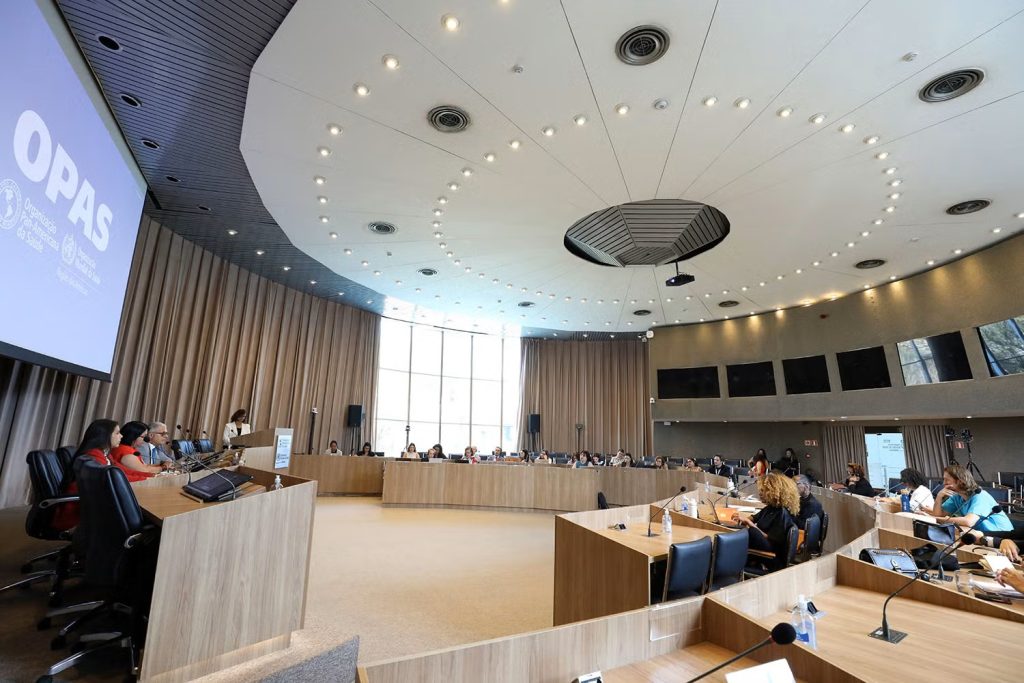
On September 21 and 22, Márcia Kalvon, Executive Director of Infinis, took part in the regional meeting promoted by the Pan American Health Organization (PAHO). The meeting brought together delegations from the Ministries of Health of approximately 20 countries in the Americas, representatives from other sectors, and partner institutions to strengthen prevention of and responses to violence against children and adolescents.
The meeting was part of the regional preparation for the Second Global Ministerial Conference to End Violence against Children and Adolescents, to be held on November 18 and 19, 2026, in Manila, Philippines. Márcia will attend the conference in person.
During the meeting, Infinis’ Executive Director spoke on behalf of the Brazilian Coalition to End Violence against Children and Adolescents, of which Infinis is one of the managing organizations and a member of the Collegiate Coordination. Her contribution focused on three priorities: strengthening the role of health in prevention, building intersectoral responses, and connecting evidence to public decision-making.
“The first message we would like to bring on this journey to Manila is quite simple: violence against children and adolescents can be prevented. This means that our challenge is not only to respond better after violence happens. We need to build policies and systems capable of getting there beforehand,” she emphasized.
Health as a gateway to protection
Márcia highlighted the strategic position of Primary Health Care (PHC), present in communities and close to children, adolescents, and their families: “This proximity supports the promotion of healthy development, support for caregivers, the identification of signs of violence and neglect, welcoming care, reporting, and coordination with the protection network.”
When presenting the results of the survey on the attitudes and perceptions of the Brazilian population regarding childhood and violence, conducted by Infinis and Quaest, she drew attention to the high level of public trust in health services.
“This increases our responsibility: if families come to these services and trust them, we must ensure that professionals are prepared to identify risk situations, provide qualified listening, and know how to activate a network that truly works,” she said.
One of the commitments undertaken by Brazil at the first global conference, in Bogotá 2024, is directly related to PHC: expanding support for parents and caregivers and training 20,000 professionals from these teams within 18 months, through the Care for Child Development strategy.
This commitment brings child development promotion and violence prevention closer together. Supporting mothers, fathers, and caregivers, strengthening bonds, and offering tools for care and positive parenting are actions that contribute to both agendas.
Shared responsibilities and responses in communities
Coordination between sectors was another central point in Márcia’s remarks. “Health, education, social assistance, the rights guarantee system, public security, and justice need to share responsibilities and build coordinated responses in communities,” she emphasized.
For Infinis’ Executive Director, 2027 offers an opportunity to advance the implementation of the Ministry of Health’s Care Pathway for Comprehensive Health Care for Children, Adolescents, and their Families in Situations of Violence, with support for states and municipalities and joint training for professionals in health, education, social assistance, and the protection network.
The preparatory meeting on the road to Manila also included representatives from the Ministry of Human Rights and Citizenship (MDHSC) and the Ministry of Foreign Affairs (MRE), from World Health Organization (WHO) Collaborating Centres for violence prevention in Brazil, from the National Council for the Rights of Children and Adolescents (Conanda), from the Youth & Survivor Summit, and from UNICEF.
In the discussions, PAHO highlighted the INSPIRE strategy as a reference for prevention, addressed risks related to child marriage and adolescent pregnancy, and underscored the impacts of violence on physical, mental, social, and reproductive health—especially on early childhood development.
Evidence to guide public policies and monitor results
Márcia also presented one of the Coalition’s recent contributions: adapting the INSPIRE indicators to the Brazilian context and making them available on the INSPIRE Platform.
“It is not enough to count incidents of violence. We also need to assess our capacity to prevent and address them,” she explained.
This involves understanding whether the children and adolescents identified by the system received care, whether services have protocols and workflows, whether professionals are prepared, and whether policies are being implemented and producing results.
“That is why, for the Coalition, producing information is only the beginning. Data must guide public decision-making. We need to be able to establish a connection between evidence, targets, responsibilities, and budget,” she concluded.
From Brasília to Manila
With a focus on prevention, the Manila conference will prioritize support for mothers, fathers, and caregivers; building safe schools that foster development; and strengthening responsive services that are welcoming and suited to the needs of children and adolescents.
The program will also address technology-facilitated violence, including violence related to artificial intelligence; the intersections between violence against children and violence against women; and protection in humanitarian and climate change contexts. Financing and regional leadership will be cross-cutting themes.
Until the conference, the preparatory process includes national sessions to review progress and strengthen countries’ commitments. Delegations are expected to update the commitments already made and submit new proposals by October 31.
Photo: PAHO/WHO