






Infinis launched a special edition of the Stanford Social Innovation Review Brazil (SSIR Brazil) on vaccination coverage in the country during the XXXVIII Congress of the National Council of Municipal Health Secretariats (Conasems), considered the world’s largest public health event. The Congress brings together managers and professionals in the field to strengthen the Unified Health System (SUS), and took place from June 15 to 18, 2025, at Expominas BH in Belo Horizonte.
“Participating in the world’s largest public health congress is a way to reinforce Infinis’ purpose in advocating for public health for children and adolescents. We believe that mobilizing essential discussions on the topic at events like this is a fundamental step toward improving our public policies,” states Marcia Kalvon, executive director of Infinis.
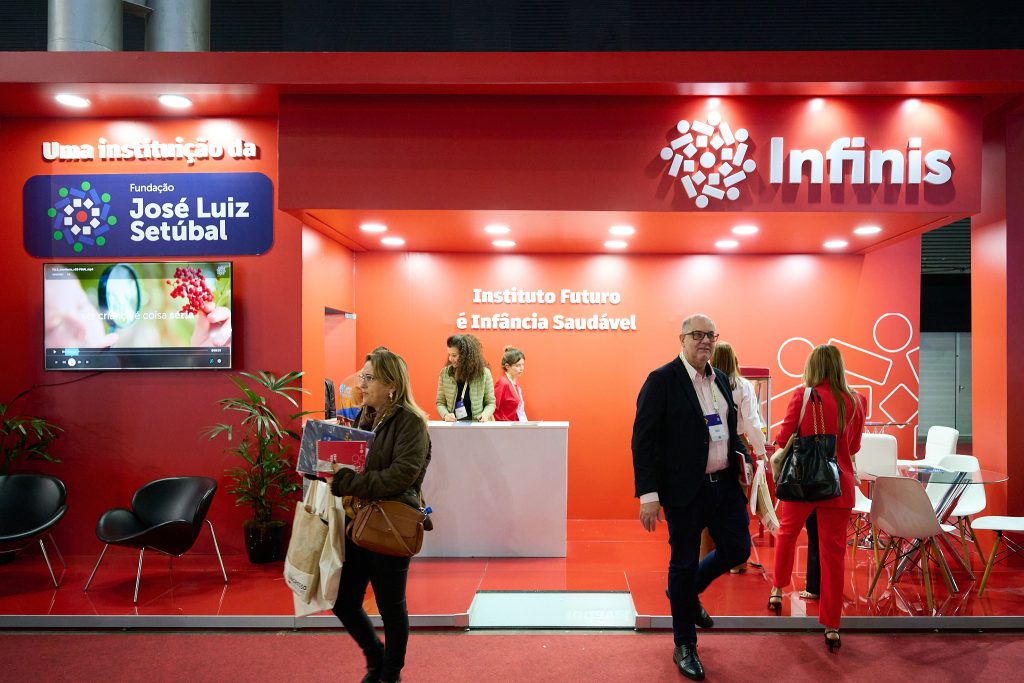
In its first participation in a health congress, Infinis presented its work and purpose to professionals in the field, focusing on one of its areas of action: advocacy for public health for children and adolescents. At the 24 m² booth, the magazine was launched with the participation of Zé Gotinha, a character from the Ministry of Health that promotes vaccination, and a space was reserved for networking, data display, and dissemination of materials on priority topics for child health.

The character Zé Gotinha participated in the release of the special edition of the Stanford Social Innovation Review Brazil (SSIR Brazil) on vaccination at the Infinis booth at the Conasems Congress in Belo Horizonte. Credit: Fernando Veloso Leão.
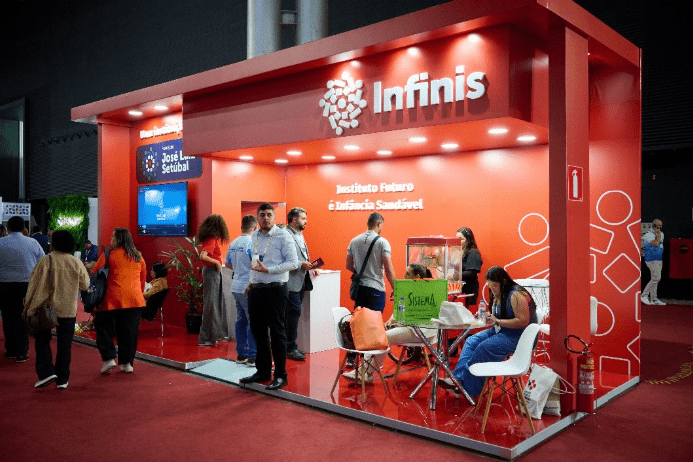
Infinis booth at the Conasems Congress in Belo Horizonte. Credit: Fernando Veloso Leão.
Stanford Social Innovation Review Brazil – special edition on immunization
The fourth special edition of SSIR Brazil, sponsored by Infinis, is dedicated to the topic of immunization, featuring seven articles developed from discussions produced at the last Public Health Policies Forum for Childhood, an initiative of the José Luiz Setúbal Foundation, in addition to the release of two original research studies.
In the letter to the reader, Dr. José Luiz Setúbal, president of the José Luiz Setúbal Foundation, emphasizes the importance of broad dissemination of studies and reliable information on the topic. He also highlights the Foundation’s contribution to building solid health solutions and public policies for Brazil.
One of the articles highlights the Active Vaccination Search (BAV), a UNICEF initiative to support local governments in identifying, registering, and monitoring unimmunized children or those at risk of not receiving vaccines. The program is developed in partnership with Pfizer and with support from the José Luiz Setúbal Foundation.
The research titled “What Brazilians Think About Vaccination of Children and Adolescents,” conducted by the Solidarity Research Network on Public Policies and Society, with support from the José Luiz Setúbal Foundation, points to the influence of disease risk perception on vaccine acceptance. For 95.3% of respondents, the meningitis vaccine is considered important. Regarding COVID-19, 21.1% would not authorize vaccination of their children, motivated by the idea of lower disease risk for children. Vaccines against HPV and dengue have refusal rates of 13.9% and 13.6%, respectively.
The second research study, “Narratives on Vaccination in the Digital Environment,” by Juliana Bonzanini and João Guilherme Bastos dos Santos, provides information regarding the influence of fake news on vaccination, highlighting the challenge of combating misinformation on social networks and media platforms such as YouTube. Official channels, such as those of Fiocruz and the Ministry of Health, are overshadowed by entertainment and news channels, which frequently dominate views and engagement, regardless of the scientific accuracy of their content.