






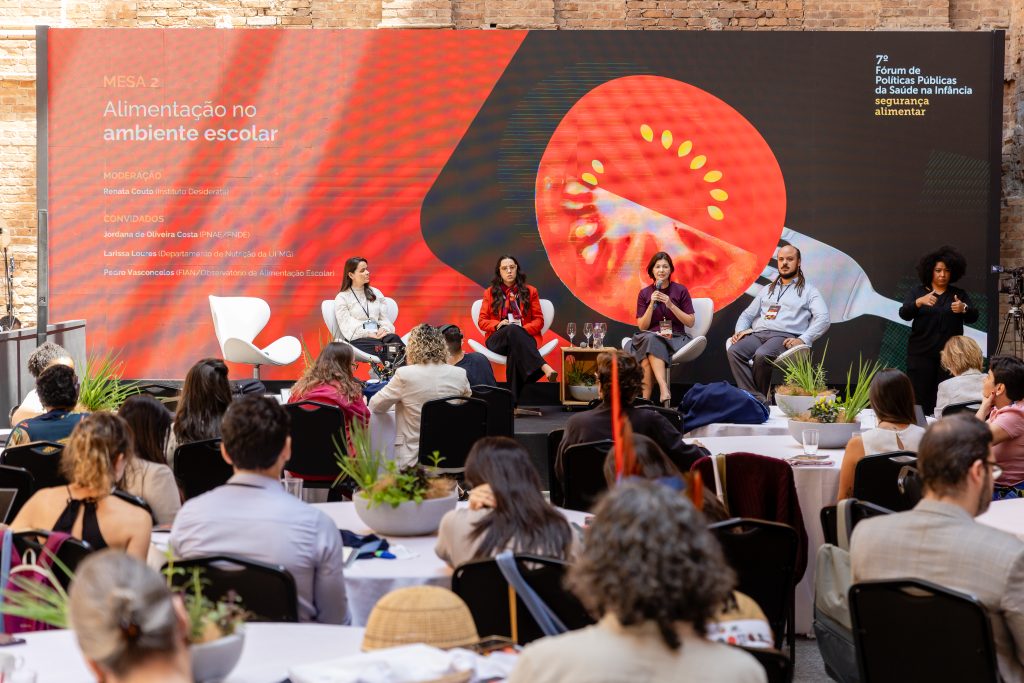
Infinis – Instituto Futuro é Infância Saudável, an organization within the José Luiz Setúbal Foundation system, held on Tuesday, September 30, 2025, the 7th Public Health Policies Forum for Childhood, at the Pinacoteca de São Paulo. National authorities, experts, academics, and representatives from the third sector gathered to debate the current situation of food security in Brazil, especially in a post-pandemic scenario, and possible intersectoral solutions for issues related to school meals, childhoods in the Amazon, and child malnutrition and obesity.
The president of the José Luiz Setúbal Foundation opened the event by drawing attention to the challenges of food insecurity in childhood and its lasting impacts throughout life. “Although Brazil has left the UN hunger map, nearly 600,000 children up to 5 years old still face severe food insecurity, meaning they go hungry,” stated philanthropist Dr. José Luiz Setúbal. He also warned about the growth of childhood obesity, another phenomenon that challenges authorities and health professionals, which already affects approximately 400,000 Brazilian children in this age group. “Addressing child food insecurity requires integrated and intersectoral actions, involving government, civil society, and families,” he emphasized.
Malnutrition and obesity: current challenges
Although undernutrition in Brazil is decreasing, the report “Feeding Profit: How Food Environments Are Failing Children“ by the United Nations Children’s Fund (UNICEF) highlighted an alarming and historic fact: for the first time, obesity surpasses malnutrition as the predominant form of poor nutrition among school-age children and adolescents worldwide. According to the report, the increase in excess weight is more pronounced in low- and middle-income countries, where more than 80% of overweight children between 5 and 19 years old live.
On this topic, the founder of the Fome Zero Institute, Walter Belik, provided a historical analysis of Brazilian food policies, from the discoveries of intellectual Josué de Castro in the 1940s to the present day, when Brazil left the Hunger Map. He also analyzed how changes in the Brazilian diet and even the cost of a healthy diet have influenced over time the existence of undernourished children in the country, while simultaneously increasing the number of children with obesity.
“Brazil is one of the world’s largest food producers, but has one of the most expensive healthy food baskets. This is a paradox that must be addressed with effective public policies,” stated Belik. According to FAO (Food and Agriculture Organization of the United Nations) data, the cost of healthy eating in Brazil exceeds the minimum wage by 43% for a family of four, being the highest in Latin America and the Caribbean, at US$4.69 per capita/day.
Belik also presented data from the Family Budget Survey (POF) showing that between 2002 and 2018, the share of ultra-processed foods in total calories increased by 3.6 percentage points, while fresh foods lost ground. “Eating habits are changing. The monotony is not only on the plate, it is in the way we choose and buy food,” he explained.
The National Secretary of Food and Nutritional Security of the Ministry of Social Development and Fight Against Hunger, Lilian Rahal, reinforced that addressing child malnutrition requires a systemic and intersectoral approach. She emphasized that healthy eating cannot be treated merely as an individual choice, but as the result of public policies that guarantee physical and economic access to food. “Hunger and obesity are expressions of a food system that is not working. We need a supply policy that reconnects production and consumption, with short circuits and valorization of family farming,” she stated.
Rahal also warned about the role of digital platforms in food marketing, which already represent 11% of retail and double in size each year. According to her, this new space can expand access to healthy foods, but also represents risks of concentration and exposure to ultra-processed foods.
For Márcia Kalvon, executive director of Infinis, the topic of food security is central to the institute’s work. Listening to experts, actors in the field, and government agents is essential for Infinis’ strategies to contribute to healthy food access for children and adolescents in Brazil. “The Forum is a special moment of pause and strategic reflection to guide our future actions on this topic,” she said.
The debate on the topic also included Kelly Poliany Alves, general coordinator of Food and Nutrition at the Ministry of Health, and Stephanie Amaral, Health and Nutrition officer at UNICEF in Brazil.
Food security for children in the Amazon
Another topic discussed at the event was food security for children in the Amazon, a region that faces challenges for child nutrition due to logistics and environmental issues, especially for indigenous populations and traditional communities.
In 2021, more than 50% of Yanomami children were in a situation of acute malnutrition, and the debate expanded on how mining, land demarcation, and difficulty accessing programs such as Bolsa Família can be challenges for the food insecurity of this and other indigenous groups in Brazil.
Adelina Fidelis, indigenous leader and president of MAPANA – Association of Indigenous Women, presented the perspective of the Ticuna community, the most numerous indigenous people in the Brazilian Amazon located in the triple border on the banks of the Solimões River. According to her, the community works with traditional indigenous production of healthy foods with the potential to be distributed in schools, such as cassava, yam, and sweet potato. MAPANA managed to mobilize so that the community’s production would be sold and included in regional school meals through the National School Feeding Program (PNAE), which came into effect in 2025. Despite the achievements already established, Adelina criticized the presence of ultra-processed foods and foods without cultural repertoire, such as soft drinks, in the meals of young people in her community. “In traditional schools we cannot fail to have traditional food. The school needs to have our food culture,” she stated.
The panel was moderated by Alexandre Ramos, project manager at Instituto Comida do Amanhã. Also participating were Anderson Serra, professor at the Federal University of Pará (UFPA), Neideana Ribeiro, Health and Nutrition Officer at UNICEF in the Manaus office, and Dora Lima, anthropologist at the Yanomami Special Indigenous Health District.
School meals and malnutrition
The discussion on school meals was guided by the National School Feeding Program (PNAE), a public policy that guarantees meals and food and nutrition education actions to students at all stages of public basic education, serving approximately 40 million Brazilian children and adolescents. The program’s guidelines include healthy and adequate food, inclusion of food education and the right to school meals, and support for sustainable development, with approximately 30% of resources for food purchases allocated to family farming production and only 15% allowed for ultra-processed foods in 2025.
Pedro Vasconcelos, general secretary of the Organization for the Human Right to Adequate Food and Nutrition (FIAN Brasil) and participant in the Executive Nucleus of the School Feeding Observatory (ÓAÊ), reinforces the importance of PNAE while highlighting some problems in its implementation, such as the difficulty of meeting the requirement of a minimum of 30% of food from family farming, problems with regularity, quantity, and quality of food supply in various schools, and persistent inequalities in implementation. To mitigate these problems, Pedro emphasizes the relevance of civil society for strengthening the policy. The organizations he represents are dedicated to monitoring and data collection through collective listening and partnerships with research centers, in addition to advocacy and political articulation in defense of the right to school meals. “Food security is a mission and right that we must always demand, after all, adequate nutrition is related to other rights such as learning and a full life,” he said.
The debate also included contributions from Larissa Loures, adjunct professor in the Department of Nutrition at the Federal University of Minas Gerais (UFMG), and Jordana de Oliveira Costa, technical officer for the National School Feeding Program (PNAE) within the National Fund for Education Development (FNDE), moderated by Renata Couto, executive director of Instituto Desiderata.
Finally, the Infinis event concluded with a debate on addressing child malnutrition.
It was announced in July 2025 that Brazil left the Hunger Map of the Food and Agriculture Organization of the United Nations (FAO/UN), an indicator it had been on since 2021. Roseane Cunha, director of the Bolsa Família Program Management Department at the National Secretariat of Citizenship Income of the Ministry of Development and Social Assistance, Family and Fight Against Hunger (MDS), believes that the Bolsa Família program played a preponderant role in this. Cunha demonstrated how intersectoral work contributes to addressing food insecurity, combining actions in health, education, social assistance, and productive inclusion. “Bolsa Família is not just a cash transfer, it is also a guarantee of social and food security,” she said. “Through social protection, we want future generations not to need Bolsa Família.”
Another public policy that contributes to youth food security analyzed in the debate was the Training Course for Adolescents and Young Health Promoters (RAP da Saúde). This is a project of the Health Promotion Superintendence (SPS) of the Municipal Health Secretariat of Rio de Janeiro (SMS-Rio) that selects and qualifies adolescents and young people between 14 and 24 years old on topics related to health promotion, disease and injury prevention, human rights, citizenship, and culture. Nathália Amorim, a 23-year-old coordinator of RAP da Saúde and former course participant, stated that there is a gap in communication and health literacy for adolescents. “How will an adolescent learn and multiply healthy eating habits if they don’t know the impact this will have on their community?” she argues, affirming RAP’s capacity to engage adolescents. “We believe that adolescents have full potential to participate in policy spaces as long as they have training.”
The panel also highlighted solutions for strengthening public policies and healthy eating habits to combat child malnutrition and obesity. Contributing to the debate were Janaína Braga, researcher at the Brazilian Research Network on Food and Nutritional Sovereignty and Security (Rede PENSSAN) and Kátia Romanelli, who works at the School Feeding Coordination of the Municipal Education Secretariat of São Paulo, moderated by Murilo Bomfim, communications manager at the Center for Epidemiological Research in Nutrition and Health (NUPENS) of the School of Public Health at the University of São Paulo (USP).
The full event can be watched on YouTube (click here).