





By Mário Augusto Almeida
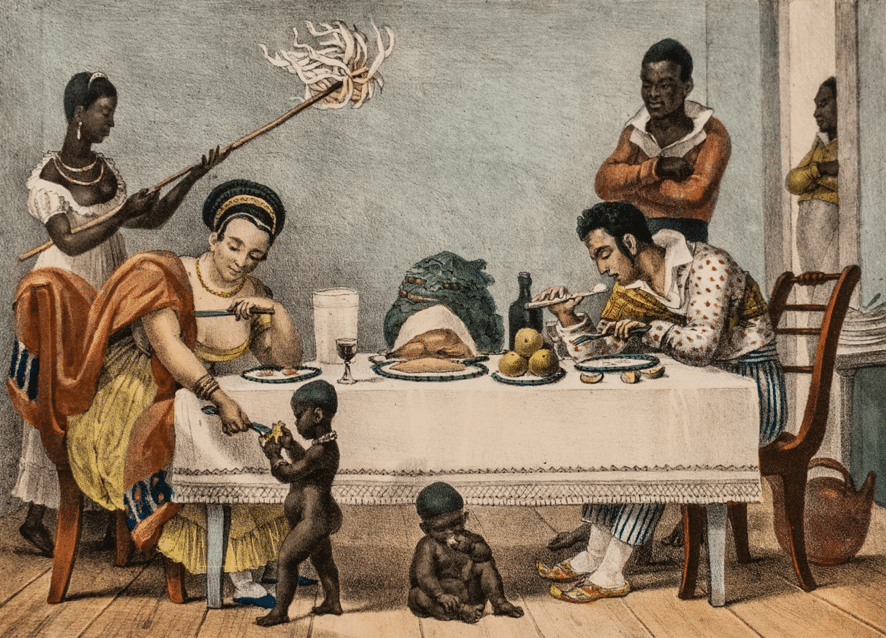
This 16x22cm watercolor on paper, dated 1827, captures a slice of reality from Brazil’s monarchical period. It depicts a white couple, apparently of means, seated at a table. In the painting, we see three Black adults standing—reportedly a man and two women—and two children in front of the table.
In the scene, two white people are seated at the table, having a meal. An enslaved woman fans the seated woman, who in turn offers food to the naked Black children on the floor, in a gesture reminiscent of feeding pets. A Black man, standing with his arms crossed, watches the couple (his owners), while another woman appears in a doorway that seems to lead to the kitchen. One detail deserves attention: only the couple at the table are wearing shoes; everyone else is barefoot.
The scene recalls an expression still common today: “I have one foot in the kitchen.” The kitchen was the place where enslaved women were seen as servants, and where their descendants, who were not dark-skinned Black people, had their identity shaped by Eugenics, a historical movement that, among the atrocities of scientific racism, advocated for the whitening of the Brazilian population.
The painting shows that, in 1827, Black children were treated like pets and, as they grew up, became bargaining chips, since, being enslaved, they held commercial value.
I write about this painting to propose a social reading of the present: in 2026, some people believe this 1827 scene no longer makes sense. So, dear reader, let’s do an initial reflection exercise. When you dine at a restaurant run by renowned chefs, who is seated and who is standing, serving? Professor Luh Souza (head of EE Pedro Moreira) called this exercise the “Neck Test.”
When we think about childhood, especially that of Black children today, certain questions arise:
- What access do most of these children have to technology?
- What environments can they access?
- What opportunities do adults offer them?
Researchers in anti-racist education point out that this inequality already appears in early childhood. According to Prof. Dr. Eliane Cavalleiro, in Do Silêncio do Lar ao Silêncio Escolar: racismo, preconceito e discriminação na educação infantil (Ed. Contexto, 2000): after observing children in daycare centers in the city of São Paulo, she found that the time spent holding white children was greater than that spent holding Black children. Prof. Dr. Jussara Santos, in Democratização do colo: Educação antirracista para e com bebês e crianças pequenas (Ed. Papirus, 2025), reaffirms this reality. (Personal interpretation.)
Therefore, the affection devoted to childhood is shaped by racial issues that precede even socioeconomic barriers. These, in turn, are just one more variable in the persistence of colonial habits in everyday Brazilian society.
If I asked you, the reader, to close your eyes right now and think of children in Africa, what images come to mind? I may be completely wrong, but I very often hear accounts describing images of Black children in a state of extreme vulnerability, deeply in need of care. It’s important to say that I’m not trying to ignore this reality, but children in Africa—a continent made up of 54 countries—also have successful childhoods. The imagery of vulnerability obscures the real strength and identity-building of Black children and adolescents throughout the world.
In 2027, Debret’s painting will turn 200 years old. In some ways, it still depicts many Brazilian dinners. Have you ever noticed that?
Angela Davis, philosopher and anti-racist activist, is often quoted for her famous phrase, which is actually a call to action, one I recall now: “It is not enough to not be racist (and I open this parenthesis because, after all, in Brazil racism is a crime and no one wants to be a criminal); it is necessary to be anti-racist (here is the call: let us be anti-racist).
Notice that we live in a Brazil where (Black) children fall from the tops of buildings after being left alone in elevators, or where stray bullets are found in the bodies of children—most of them Black. If we fail to look at ways to change these realities, we will keep witnessing atrocities that are too often already normalized or rendered invisible.
When did we stop paying attention to the data in the reports from the Violence Atlas of the Brazilian Forum on Public Security? Thinking about equity means thinking about real democracy. It means remembering that guaranteeing the right to life is democracy itself.
And when these Black children reach adolescence, what conditions do they find to build relationships, experience their sexuality, and imagine their own future? According to the 2026 Violence Atlas, Black people accounted for 77% of homicide victims in 2024, revealing a form of violence that cuts lives short, breaks family bonds, and prevents dreams from being fulfilled.
Racial inequalities also affect sexual and reproductive health: 2020 data compiled by the Ministry of Health show that adolescents accounted for 16.7% of births among mixed-race (“parda”) mothers and 13% among Black mothers, compared to 9.2% among white mothers. These figures underscore the need to ensure sex education, access to contraception, and protection from violence, recognizing that unintended teenage pregnancy involves inequalities and barriers to the exercise of rights.
It is also essential to recognize Black adolescents for their strengths: they are individuals who build their identities, affirm their sense of belonging, and claim their place in society. Anti-racist education, one that embraces their experiences and values their knowledge, can expand opportunities for social mobility and the fulfillment of dreams. To achieve this, it is necessary to ensure concrete conditions so they can stay in school, make their own choices, and chart their own paths.
Throughout history, many initiatives have contributed to building a country that guarantees rights equally for all. Education is one of the most solid paths toward expanding this understanding and turning it into practice.
In 2003, the Brazilian Government enacted Law 10,639, which made it mandatory to teach the History of Africa and Africans, as well as the struggle of Black people in Brazil and their contributions to our country’s history. Note that it has been just over 23 years, and Education has made progress on this front.
It is well known that the Black population’s access to schooling through legal channels is recent in our history; however, through social movements and quilombo-building efforts, Black communities have long sought to be included in educational curricula.
Teacher training is essential to this transformation. When educators receive ongoing training about their country’s history from a non-Eurocentric perspective, they tend to develop a more empathetic view of Black and Indigenous students (Law No. 11,645/2008) and to foster the development of these students’ identities and potential. On this, Antônio Bispo dos Santos (Nêgo Bispo) said: “When one river meets another, it does not stop being a river—it becomes a bigger river.”
This movement fosters a unique connection between students and their educators. When students encounter their own history, they strengthen their abilities, and the environment becomes more open to empathy among peers and a greater sense of belonging to their community. It is essential to see oneself represented through one’s own potential.
To be clear, curricular racism attributes humanity’s great inventions to the Global North, even entertaining, for example, the idea that the Pyramids of Egypt may have been built by extraterrestrials rather than by Egyptians, who were Black people. There’s an African saying about this: “Until the lion tells his own story, the hunter will always be the hero.” Thus, small acts of violence in school mark the entire educational journey of every individual, whether Black or not.
I reaffirm the need for educators to receive ongoing training in Education for Ethnic-Racial Relations (ERER), and to offer literature produced by Black and Indigenous authors, beyond what is established in the school curriculum. Literature has the power to transform imagery and narrow the gaps established over more than 526 years of this country’s official existence.
By now, you may be asking yourself: what’s the point of schools changing if family values don’t? You’re right! It’s essential for Education to build partnerships to carry out its work. But how truly ready is the school to welcome family participation while still fulfilling the role it must never abandon: that of producing knowledge and promoting social mobility? It is impossible for schools alone to transform realities, especially mindsets so deeply rooted in our country’s culture.
Another important question, dear reader, is how you come to terms with the history of your own origins. How much pent-up affection, how many dreams did you set aside to follow a path that was really the dream of your parents, grandparents, or great-grandparents? How many times, as a child, were you asked: “What do you want to be when you grow up?” when, in truth, simply being a child would have been enough. The future does not lie in the child—it lies in what you, as an adult, leave behind as a legacy and a dream for today’s children.
It is not wrong to go back and pick up what you forgot. (Sankofa)
This is a brief reflection in honor of Black Awareness Day – Zumbi dos Palmares, and World Children’s Day, but remember: the awareness of being Black, for those who are Black, is present all year round. How can you contribute to affirmatively supporting this process of identity-building?
About the author
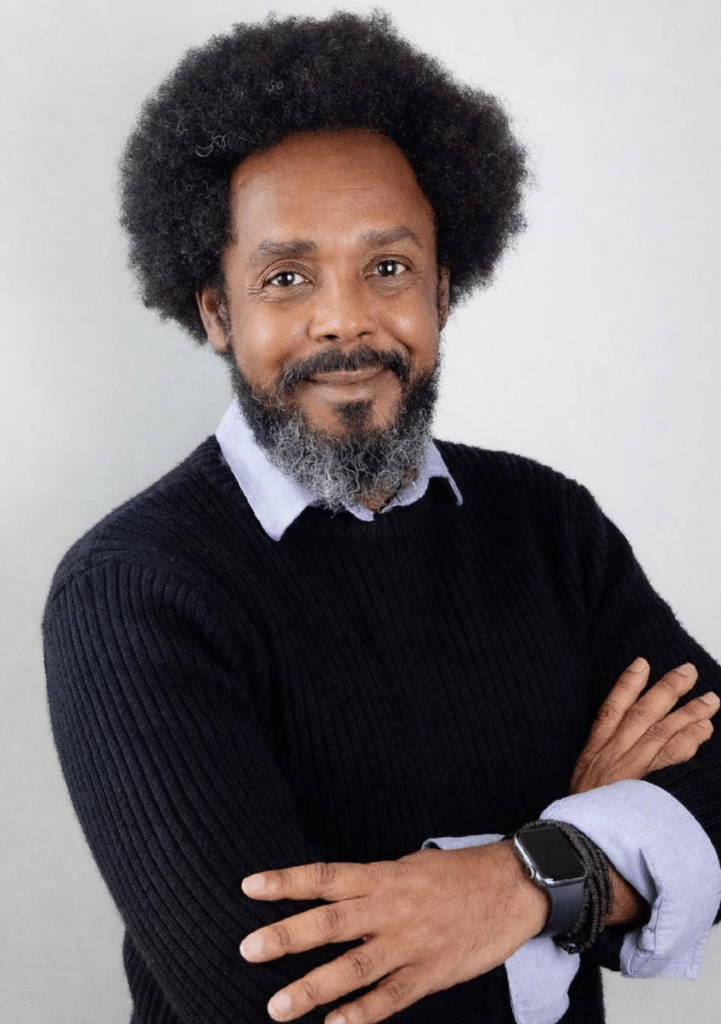
Mário Augusto is a Black man and psychologist from the University of Guarulhos. During the pandemic, he led the School Coexistence and Protection Improvement Program at Seduc-SP, better known as CONVIVA-SP, and headed Anti-Racist Education at the same department. In 2023, in the state of Pará, he took part in implementing the Educational Coexistence Advisory Office and led the Diversity and Inclusion Department at Seduc-PA. Today, Mário Augusto practices Clinical Psychology with a psychoanalytic orientation in São Paulo.