






The study “Monitoring and Non-Compliance with Conditionalities in the Bolsa Família Program focused on Early Childhood,” prepared by the Ministry of Development and Social Assistance, Family and Fight Against Hunger (MDS) with support from Infinis – Healthy Childhood Future Institute and the Maria Cecilia Souto Vidigal Foundation (FMCSV), in technical partnership with Lab Social – Innovation in Social Assistance, provides a diagnosis of the main challenges faced by municipalities in managing the health and education conditionalities of the Bolsa Família Program (PBF) and presents recommendations to strengthen the integral protection of children in early childhood, based on best practices identified in the territories.
The study starts from the perspective that the program’s conditionalities are an important mechanism for accessing rights, rather than understanding them as instruments of punishment. In this way, they act as an indicator of social vulnerability, capable of guiding active search and family protection actions.
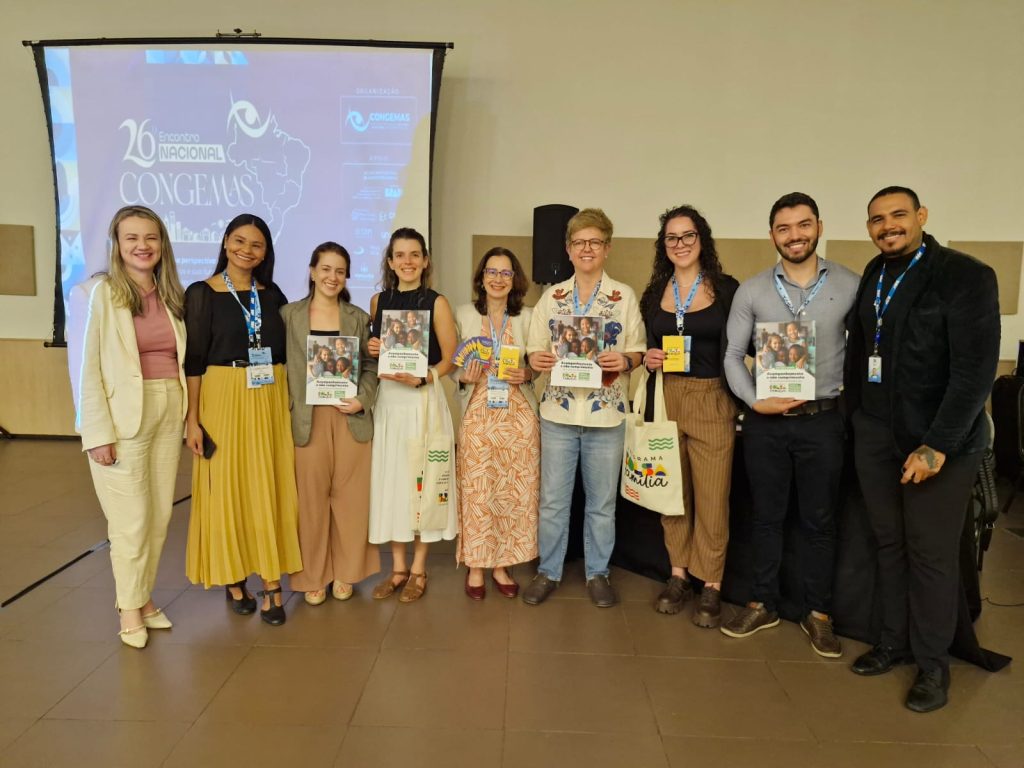
MDS holds a workshop to present the study during the 26th National Meeting of CONGEMAS
The results of the study on the conditionalities of the Bolsa Família Program were presented during the 26th National Meeting of the National Board of Municipal Social Assistance Managers (CONGEMAS), held between June 16 and 19 in Fortaleza (CE), considered the largest meeting of Brazilian social assistance. The program included a workshop promoted by the Ministry of Development and Social Assistance, Family and Fight Against Hunger (MDS), dedicated to deepening the research findings and discussing strategies to qualify the management of conditionalities focused on early childhood. Infinis was present at the meeting.
Aimed at municipal social assistance managers, municipal technical teams, health and education professionals, and basic and special social protection workers, the workshop aimed to strengthen the role of professionals in identifying and monitoring families in situations of vulnerability. After the presentation of the results, participants were divided into groups to work on a case study, applying the study’s recommendations for the qualification of monitoring and compliance with conditionalities.
The main challenges indicated by the study
The study highlights that the differences in the results achieved by municipalities are not only related to the socioeconomic characteristics of the territories, but, above all, to the practices, institutional arrangements, and management processes adopted at the local level. The research demonstrates that the best results are obtained when municipal teams manage to integrate the use of data, strengthen intersectoral coordination, and incorporate social work as an effective protection strategy for families.
Among the main challenges identified, the fragility in the integration between information systems and in communication between health, education, and social assistance policies stands out. This fragmentation hinders the continuous monitoring of families, limits the coordinated action of municipal teams, and reduces the potential of conditionalities as an instrument for the early identification of vulnerabilities and the promotion of social protection.
Furthermore, the research points to great variability in results among municipalities with similar profiles, indicating that the quality of local management plays a decisive role in performance. The study also reveals that conditionalities are still poorly integrated into the social work developed by the Integral Family Protection and Assistance Service (PAIF) and family monitoring, reinforcing the need to strengthen the technical capacity of teams, promote integration between systems, and invest in continuous training and support processes for professionals.
Recommendations to strengthen social protection
The study presents a set of recommendations aimed at strengthening the performance of municipalities and the coordination between public policies.
Among them are the prioritization of territorialized active searches for families identified as non-compliant with conditionalities in the Conditionality System (SICON); the use of the Temporary Interruption of Non-Compliance Effects, a tool that allows for the temporary suspension of benefit blocks while social assistance monitors the family to address the causes of vulnerability; and the strengthening of intersectoral action between the Family Health Strategy, Education, and the Unified Social Assistance System (SUAS) teams.
In the area of health, the study reinforces the importance of expanding vaccination coverage, ensuring prenatal care, and regularly monitoring the nutritional development of children up to seven years old. In education, it highlights the need to ensure the minimum required school attendance for children aged four and five and to act early in cases of non-attendance, preventing school dropout. The main interest is that the recommendations reach the territories and contribute to the management of conditionalities in the municipalities.
For Sofia Rebehy, Project and Program Coordinator at Infinis, supporting evidence-based initiatives is essential to qualify public policies aimed at childhood:
“In addition to the analysis of secondary data, the study included listening to municipal teams involved in the management of Health and Education conditionalities of the Bolsa Família Program related to early childhood to identify challenges and best practices of this work in the territories. Starting from this evidence was a fundamental step in preparing recommendations for the Federal Government and municipalities to improve the program, which plays a fundamental role in reducing vulnerability in the first years of life.”
By supporting the study, Infinis reaffirms its commitment to strengthening evidence-based public policies aimed at guaranteeing the rights of children and adolescents, contributing to strategic programs like Bolsa Família expanding their capacity to promote social protection and healthy development from the first years of life.