






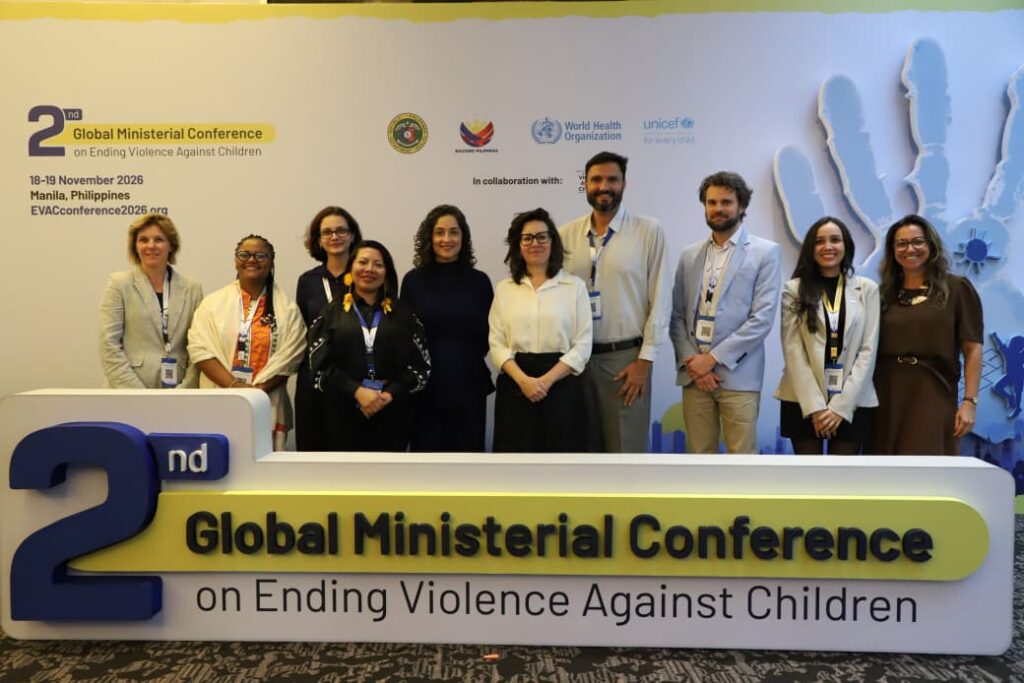
Infinis participated in the 2nd Global Ministerial Conference on Ending Violence Against Children, which took place on November 18 and 19 in Manila, Philippines. The meeting brought together representatives from 129 delegations, including 66 Ministers of State, and more than a thousand participants. The conference aims to promote the exchange of experiences, the evaluation of international commitments, and the construction of joint strategies to prevent and address different forms of violence.
Márcia Kalvon, executive director of Infinis, and Lucas José Ramos Lopes, executive secretary of the Brazilian Coalition to End Violence against Children and Adolescents, represent the Coalition at the meeting. Infinis is part of the network’s collective coordination.
Organized by the government of the Philippines, the World Health Organization (WHO), and UNICEF, the conference continues the discussions started in Bogotá, Colombia, in 2024, when Brazil made eight commitments. In this edition, the Brazilian delegation, led by the Minister of Human Rights and Citizenship, Janine Mello, presented ten new commitments. Among them are goals to qualify care in the health network, expand prevention in schools, and strengthen the protection of indigenous children and adolescents.
Infinis’ participation in Manila follows the coordination initiated at the Pan American Health Organization (PAHO) preparatory meeting, held in September in Brasília. On that occasion, Márcia highlighted the role of primary health care in the early identification of violence situations and in coordination with the protection network. She also presented the INSPIRE Brazil Platform, a Coalition initiative that gathers indicators on violence against children and adolescents and provides a section to monitor the commitments made by the country at ministerial conferences.
For Infinis, monitoring these commitments is part of the prevention work. Goals with defined deadlines allow civil society to follow the implementation of measures and contribute to ensuring they translate into protection and care in local communities.
“Participating in the conference in Manila alongside the Coalition was an opportunity to bring Brazilian priorities for preventing violence against children and adolescents to the international debate and to learn about what other countries have been doing. This exchange helps in thinking about concrete responses for Brazil, from protection in the digital environment to improving care for those who have already suffered violence,” said Márcia Kalvon, executive director of Infinis.
The ten commitments presented by Brazil in Manila
- Child marriage. Develop guidelines and recommendations to address the sexual abuse and exploitation of children and adolescents associated with child marriage.
- Protection in the digital environment. Strengthen the national response to severe forms of online violence and combat the production and circulation of sexual content images involving children and adolescents.
- Prevention of drug use and violence associated with illicit trade. Expand drug use prevention actions, including problematic use, and protect children, adolescents, and young people from recruitment and violence associated with the illicit drug trade.
- Safety in educational institutions. Develop and consolidate the public security action protocol to prevent and respond to acts of extreme violence in educational institutions.
- Comprehensive health care. Improve care for children and adolescents in situations of violence, with workshops in the 26 states and the Federal District and the training of 10,000 health professionals by 2028.
- Prevention in schools. Ensure that, by 2030, at least 65% of public schools participating in the Health at School Program carry out at least one intersectoral action to prevent violence against children and adolescents each year.
- 24-hour psychosocial care. Regulate and fund the Child and Adolescent Psychosocial Care Centers III (CAPS ij III) to serve children and adolescents in crisis or intense psychological distress, including situations related to the use of alcohol and other drugs.
- Child and Adolescent Shelter Units. Improve and expand the units, updating their regulation, care modalities, team composition, monitoring indicators, and funding, with supply scaled according to local needs.
- Training for the protection of indigenous children and adolescents. Train, between 2027 and 2028, professionals and indigenous representatives to identify, report, and handle situations of violence using an intercultural approach.
- Care pathway for indigenous children and adolescents. Develop and publish, by December 2028, guidelines to prevent and respond to violence, respecting the sociocultural and territorial specificities of indigenous peoples and strengthening the coordination of the protection network.